

Why France still smokes more than its European neighbours
France has one of Europe’s most ambitious anti-smoking policies. Yet it still has more smokers than most of its neighbours. After two decades of price rises and prohibitions, is its model beginning to reach its limits?
France ought to be a particularly difficult place to be a smoker. A packet of the best-selling cigarettes costs about €13.50, 84% more than the EU average. It comes in standardised packaging, much of it covered with pictures of cancers and other diseases. Tobacco advertising has all but disappeared. Smoking is banned in offices, restaurants and public transport and, since 2025, in a growing number of outdoor spaces frequented by children. The official goal, announced by Emmanuel Macron, France’s president, in 2021, is now a “tobacco-free generation”.
And the policy has largely worked.
In 2014 a quarter of French people aged 18 to 75 smoked every day. By 2024 the share had fallen to 18%. Santé publique France, the national public-health agency, estimates that France now has 4m fewer daily smokers than when its first big national programme to reduce smoking was launched. The government has good reason to celebrate.
“The historic decline in smoking, among adults as well as young people, shows that a comprehensive, ambitious and sustained policy works,” Nicolas Prisse, then head of France’s interministerial mission on drugs and addictive behaviour, said in 2025.
There is, however, a problem that is becoming hard to ignore: the French still smoke a lot—and considerably more than most of their European neighbours.
International comparisons are never perfectly like-for-like, but OECD figures give a sense of the gap. In comparable data for 2022, 25% of French adults smoked daily, against 18% across the European Union, 12% in Denmark, 11% in Finland and 9% in Sweden. In Britain the figure was 11%.
In western Europe, France looked more like an outlier than a model.
The paradox is all the more striking because Paris can hardly be accused of being soft on smoking. The Tobacco Control Scale, which ranks European policies according to cigarette prices, smoking bans, advertising restrictions, health warnings, public campaigns and support for quitting, regularly places France among the continent’s most interventionist countries.
France has thus long combined two characteristics that ought not readily to coexist: an unusually muscular anti-smoking policy and an unusually high rate of cigarette smoking.
Why this is so matters well beyond France. Rich countries have already persuaded many of the people most inclined to quit to do so. The fight is increasingly shifting towards a smaller group of smokers who are more dependent and often poorer. The policies that brought smoking rates down from 30% to 20% will not necessarily be the ones that take them from 20% to 5%.
A taxing habit
France’s anti-smoking policy is made within a relatively tight circle. The same actors have sat around the table for years: government officials, public-health agencies and specialist associations, several of them heavily reliant on public funding. The former fund, consult and work with the latter; the latter, in turn, help shape the expertise and debate on which policymakers rely.
This close-knit ecosystem has fostered a strong consensus around the same set of tools: taxation first, followed by the denormalisation of smoking and help with quitting.
Between 2016 and 2020, the price of the best-selling packet of cigarettes duly rose by 41%. The increase was accompanied by plain packaging, the annual Mois sans tabac (“Tobacco-free month”) campaign and reimbursement for nicotine-replacement therapies.
On paper, the logic works admirably. Tobacco taxes are among the best-established tools in public health: when cigarettes become more expensive, consumption falls, quit attempts rise and fewer young people take up smoking.
An OECD assessment in 2023 was particularly favourable to the French strategy. Modelling the effects of the package of measures introduced between 2016 and 2020, it projected substantial health and economic benefits over the long term.
Yet if taxation works, the French experience shows that smokers do not respond to higher prices in a simply binary way.
When the price of a packet rises by €2, after all, its buyer does not face only two choices: pay up or quit. He can smoke less, switch to a cheaper product or buy his cigarettes elsewhere. Such efforts to dodge higher prices are common enough to show up in the data. A 2024 meta-analysis in Addiction, covering 68 studies, found that tobacco-tax rises prompt a range of strategies for paying less, from switching to roll-your-own tobacco to buying across the border.
The wider the gap between French prices and those available through other channels, the more attractive such alternatives become.
Smokes off the books
No one knows exactly how many of the cigarettes smoked in France are bought outside the country’s network of licensed tobacconists. Estimates vary wildly—and the size of the disagreement has itself become a political issue.
The first large-scale official estimate, commissioned by French customs and MILDECA, the government body responsible for drugs and addictive behaviour, was published in 2025. It reckoned that 17.7% of the tobacco consumed in France in 2023 had escaped French taxation, with a range of 12.3-22.4%. A second method used in the same study put the figure at 19.2%. Most of it was thought to come from cross-border purchases. France’s geography gives smokers plenty of opportunities to buy cheaper cigarettes abroad, while also making it easier to supply the networks that sell contraband tobacco at home.
Other estimates are far higher. An EY-IFOP study published in 2024 and funded by Philip Morris France and Japan Tobacco International France put the parallel market at 38% of consumption in 2023, up from 23% in 2019. Other studies commissioned by the tobacco industry have produced still higher figures. Public-health bodies dispute such estimates, not least because methodologies and definitions differ, and because legal cross-border purchases are sometimes lumped together with illicit trade.
One thing is less open to dispute: seizures remain enormous. In 2025 French customs intercepted 548 tonnes of tobacco within France, 12% more than the year before, and recorded more than 20,000 offences. It also helped seize a further 284 tonnes abroad.
Whatever the true numbers, the awkward result is much the same: smokers keep smoking but stop paying the price that Paris raised precisely to persuade them to quit.
Down Under the counter
The proximity of Luxembourg, Andorra and Spain offers a tempting explanation for France’s predicament. But it cannot be the whole story.
To see why, look some 17,000km from Paris. Australia has neither Luxembourg nor Andorra on its doorstep. On the contrary, it has some of the easiest borders to police in the developed world. It also combines some of the world’s most expensive legal cigarettes (€23-28 a packet) with particularly stringent restrictions on tobacco and nicotine products. Yet its black market is booming.
New estimates from the Australian Bureau of Statistics paint an even starker picture. Using nicotine metabolites found in wastewater, the ABS estimates that total nicotine consumption rose by almost 40% between 2017 and 2025, even as consumption of legal tobacco fell to less than a third of its 2017 level. Illicit cigarettes, e-cigarettes and other nicotine products more than made up the difference. By 2025, illicit sources accounted for 80% of nicotine consumption. Per person, total nicotine consumption was 22% higher than in 2017.
Quantity of cigarettes and tobacco consumed, quarterly original in Australia
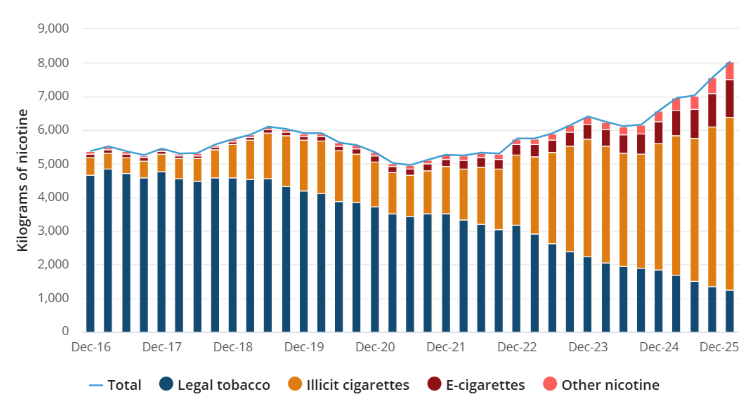
Source: Australian Bureau of Statistics (2026)
Australia’s experience is not a straightforward argument against tobacco taxes. But it does raise a more fundamental question. When a smoker decides that legal cigarettes have become too expensive, where exactly does public policy want him to go?
Switching sides
Across the Channel, the answer is rather less ambiguous.
Britain, too, taxes cigarettes heavily (a packet costs about €21) and has imposed stringent restrictions on smoking for years. But its health authorities have adopted a markedly different philosophy towards nicotine.
The NHS tells smokers that vaping is “not risk-free”, but poses only a small fraction of the risk of smoking. It also says that nicotine e-cigarettes are among the most effective tools for quitting.
The difference may sound semantic. It is not.
Under the British approach, a smoker who switches entirely from cigarettes to vaping has achieved much of the desired health gain, even if he remains addicted to nicotine.
France has traditionally been more cautious.
In a 2021 opinion, France’s High Council for Public Health concluded that the available evidence was insufficient for health professionals to recommend e-cigarettes as an aid to quitting smoking.
The French position has since evolved. The national health-insurance system now acknowledges that vaping “can be an effective tool for quitting smoking”. But it immediately adds a second objective: “stopping smoking, then stopping vaping”.
The philosophical distinction looks tiny. In practice, it is substantial.
For London, permanent substitution can be an acceptable outcome. For Paris, it looks more like a staging post on the road to abstinence.
British statistics provide at least some reason to take the distinction seriously. In 2024, according to the Office for National Statistics, 10.6% of British adults smoked cigarettes, down from 20.2% in 2011. In a separate ONS survey covering Great Britain, current e-cigarette users outnumbered smokers for the first time: 10% versus 9.1%.
None of this proves that vaping explains the gap with France. Smoking trends are shaped by taxation, income, social norms, education, regulation and each country’s history.
But Britain has plainly shifted some nicotine consumption away from combustion and towards another technology.
A Swedish paradox
Sweden takes this logic much further.
It now has the lowest daily smoking rate in the European Union. According to the OECD’s 2025 health profile, the rate fell from 12% in 2014 to below 9% in 2023. Yet Swedes have hardly given up nicotine.
In 2024 more than 15% of people aged 16 and over used tobacco-containing snus every day, according to the OECD; another 5% or so used tobacco-free versions.
The OECD does more than simply place these figures side by side. It says Sweden’s low smoking rate is “largely attributed” to the substitution of snus for cigarettes.
In late 2024 the Swedish government effectively formalised this philosophy by shifting its policy: rather than focusing solely on reducing tobacco use, it put greater emphasis on reducing the harm it causes.
It is almost the mirror image of the French experiment. Sweden tolerates plenty of nicotine and very few cigarettes. France would ideally like little of either.
The contrast has now produced a very tangible quarrel. France’s decision to ban nicotine pouches prompted objections from Stockholm in 2026. Benjamin Dousa, Sweden’s trade minister, called the French ban an “attack on the Swedish way of life”.
The phrase may invite a smile. The argument behind it is serious. What, exactly, is public-health policy trying to defeat: tobacco, nicotine or the cigarette?
The fire, not the nicotine
For decades, the distinction mattered relatively little. Nicotine was consumed mainly through a remarkably lethal delivery system: a tobacco leaf, set alight and inhaled.
New technologies have pulled the two apart.
Nicotine is addictive. It affects the cardiovascular system, temporarily raising heart rate and blood pressure, and exposure is of particular concern during pregnancy and adolescence. But most of the extraordinary harm caused by cigarettes comes from combustion. Britain’s NHS puts the point particularly plainly: it is the thousands of chemicals in cigarette smoke that cause most of the damage associated with smoking.
That does not make e-cigarettes or nicotine pouches harmless. Their long-term effects are less well understood; addiction remains; and their popularity among young people is a genuine concern. A product that may be useful to a 55-year-old smoker can be decidedly unwelcome in the hands of a 15-year-old.
Public policy therefore has two problems to solve at once: keeping non-smokers away from nicotine while giving persistent smokers a way out of cigarettes.
France appears particularly good at the first. Smoking among young people has fallen spectacularly. That may be the greatest achievement of French tobacco policy—and another reason not to call it a failure.
Its harder problem is the smokers who remain.
France’s last smokers
They are hardly a representative sample of the French population.
In 2024, 30% of people who said they were struggling financially smoked every day, compared with just 10.1% of those who described themselves as financially comfortable. Among manual workers the rate was 25.1%; among managers and professionals, 11.8%.
More than half of daily smokers—55%—say they want to quit. But the better-educated and those in professional occupations are also more likely to succeed in doing so.
This is where France’s strategy may run into its hardest problem.
The first decades of tobacco control picked off some of the smokers easiest to persuade. Those who remain are more likely to be heavily dependent, financially vulnerable and less responsive to public-health campaigns.
For them, another increase in the price of a packet may not have the same effect as it does on a student who smokes occasionally. It may prompt them to quit. But it may also prompt a trip to Belgium. Or a switch to an e-cigarette. Or the purchase of a contraband packet.
As the number of smokers dwindles, where those who will not quit end up becomes as important as the pressure applied to make them leave.
France may be winning after all
There is, finally, a much simpler explanation for the French paradox.
Perhaps it just needs time.
The figures for 2024 are striking. Among a comparable population, daily smoking fell from around 25% in 2021 to 18% in 2024. Methodological changes call for caution when making comparisons, but the long-term trend is unmistakable.
France may therefore be less a counter-example to conventional tobacco control than a demonstration of how slowly it works.
That possibility deserves to be taken seriously. Plain packaging, tax rises, Mois sans tabac, reimbursement for nicotine-replacement therapies and the denormalisation of smoking may have cumulative effects. Teenagers who do not start smoking today become the non-smoking adults of tomorrow.
It would therefore be foolish to abandon a policy just as it is producing some of its best results.
But its success is, paradoxically, changing the nature of the problem.
France no longer needs, above all, to persuade the general population that smoking is dangerous. It needs to reach a hard core of more dependent and socially disadvantaged smokers, while preventing a new generation from becoming addicted to nicotine.
For this last stretch, price will remain a powerful tool. It may no longer be enough.
For 20 years, French tobacco policy has largely sought to answer one question: how can cigarettes be made expensive, difficult and undesirable enough to persuade the French to stop smoking?
The experiences of Australia, Britain and Sweden suggest a second.
If they do not quit, what do we want them to do instead?